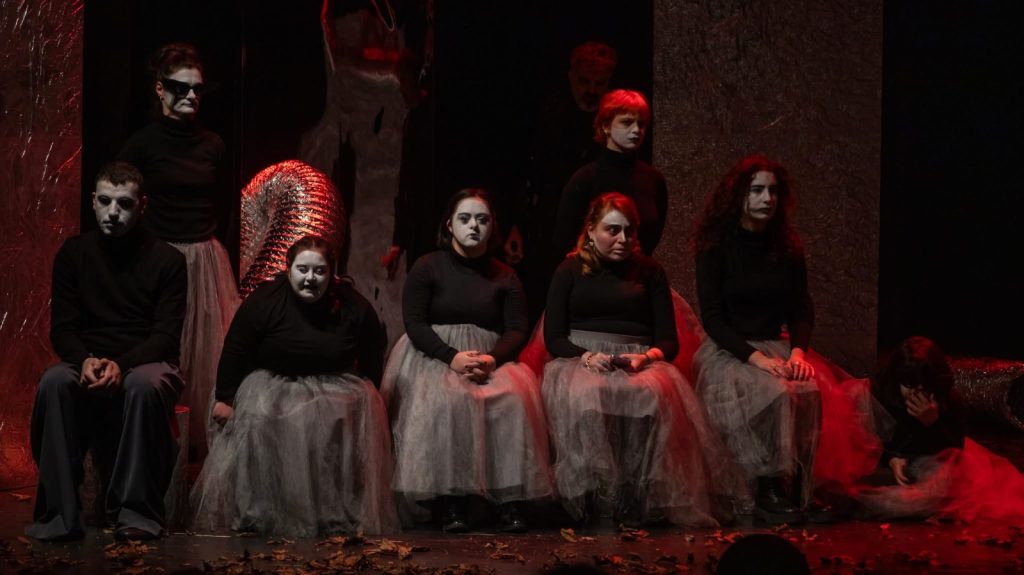
“This story, on the one hand, tells of the mythological sun god Helios; yet at the same time, it bears no direct connection to the Greek myth. In the performance, Helios does not represent a human being or a distinct persona; rather, he serves as a symbolic key to the path of self-awareness for individuals existing within a vacuum of thought. The essence of Helios is revealed only in the concluding part of the narrative.
The main action unfolds in a simulated world, within a mirrored room where the population exists in a zombified, ‘asleep’ state. People, bound to their screens, receive urgent broadcasts from a television and radio announcer, warning that ‘Helios’ may appear in their world and urging them to remain vigilant.
Tension becomes apparent among members of this society. They respond to the information in different ways and form varied expectations regarding the possible appearance of Helios. Some perceive his arrival as the coming of a savior.
The performance portrays the distinctive features of a society in crisis, confined within a digital room: inner chaos and emotional turbulence, confrontation with oneself and with others, fragmentation, arrogance, a sense of inner emptiness, cynicism, duplicity, toxic positivity, and a kind of naïve innocence manifested in everyday life.
Against the backdrop of a psychological crisis, members of the population begin offering one another pseudo-spiritual and personal growth services, as well as superficial and profane forms of assistance.
Nevertheless, a small portion of individuals becomes more acutely aware of the existing mental traps and illusions. A reassessment of values begins, accompanied by attempts at self-reflection.
The processes unfolding within the room are carefully observed by advanced beings from another time and dimension, who periodically assume the role of narrators and analyze the situation within the space.
At a certain moment, the broadcast suddenly ceases. In its absence, existential questions begin to surface among members of the society, and the call of one’s own soul becomes perceptible. Interest in the appearance of Helios intensifies further and reaches its climax.
For some, Helios may represent a new source of light and vital energy. At the same time, his fierce yet just radiance has the power to burn away and destroy established comfort zones. The dualistic nature of this celestial force reminds humanity of the principle of cosmic justice — a principle that the modern individual has either forgotten or come to interpret differently.”
(Copyright protected)